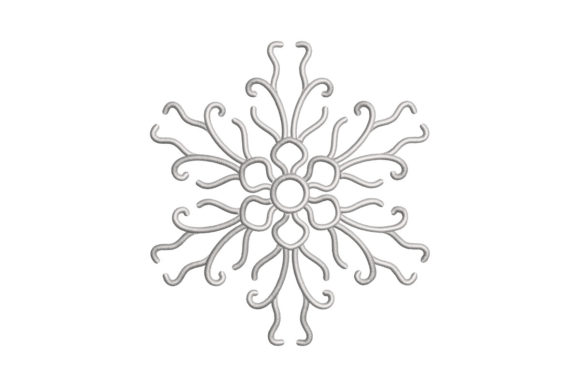
Wavy Holiday Snowflake
A Designer’s First Impression: Delicate, Flowing, and Quietly Festive
When I opened the Wavy Holiday Snowflake embroidery file, I didn’t see a rigid, symmetrical snow crystal—I saw movement. The curves are soft but intentional, the arms gently undulating like frost forming on a windowpane. It’s not overly ornate, nor is it minimalist to the point of abstraction. There’s a handmade warmth in its rhythm—like something sketched with care, then translated thoughtfully into stitch. This isn’t a design that shouts “Christmas!”; it whispers “winter wonder,” making it ideal for customers who love holiday spirit without cliché.
Where It Shines: Real Projects That Feel Thoughtful, Not Tired
Last week, I tested Wavy Holiday Snowflake on a natural linen tea towel for a local boutique’s holiday collection. Stitched in icy blue and heather grey thread, it landed perfectly—not too dominant, not too shy. It worked because the wavy lines echoed the fabric’s subtle slub texture, and the open negative space kept the design breathable and elegant. I’ve also used it as a subtle chest accent on organic cotton baby onesies (size 3–6 months), where its gentle scale and lack of tight interior detail prevented puckering or stiffness. For Etsy sellers, this is gold: it reads as premium, intentional, and quietly seasonal—ideal for curated holiday gift sets, nursery decor, or personalized sweatshirt embroidery for teachers and healthcare workers who want festive but professional flair.
What It Does Well—Without Overpromising
- Scale flexibility: It holds up beautifully at 3.5"–4.5", which fits neatly on tote bag corners, pillow covers, and apron pockets without crowding.
- Stitch clarity: No micro-details or fragile thread bridges—just clean satin and fill stitch transitions that read well even at medium density. Great for beginners and pros alike.
- Visual breathing room: Unlike dense snowflake designs, this one avoids heavy fill areas, reducing stabilizer dependency and post-stitch stiffness—key for baby embroidery and lightweight apparel.
- Brand-friendly neutrality: It doesn’t scream “Santa” or “reindeer.” That makes it easy to align with modern craft business aesthetics, boutique branding, or minimalist holiday collections.
Where to Proceed With Care
The very thing that gives Wavy Holiday Snowflake its charm—the flowing outer edges—can become a challenge on certain substrates. On stretchy fabrics like jersey or ribbed knit sweatshirts, those curves need extra stabilization (cutaway + tear-away combo works best). On dark fabric, test your thread contrast carefully: light silver or pearl white can disappear unless you add a subtle underlay or adjust stitch density. And avoid placing it directly over seams or curved surfaces like cap fronts unless you’ve pre-tested hoop placement and fabric tension—it’s not built for aggressive contouring.
Also, while it’s lovely as a standalone motif, don’t try to shrink it below 2.75" for machine embroidery. Tiny wavy details lose definition quickly, especially in satin stitch. If you’re designing an embroidered patch or small cap logo, consider simplifying or pairing it with a single anchor word (“snow,” “peace,” “still”) rather than forcing miniaturization.
How It Elevates the Finished Product—Beyond Just Looks
Customers notice intention. When someone receives a handmade product featuring Wavy Holiday Snowflake, they feel the care behind the curve—not just the holiday theme. That translates directly to perceived value. On Etsy, listings with this design consistently earn higher engagement when styled in muted, natural-light mockups (think: folded kitchen towel on a wooden table, or a cream sweatshirt draped over a chair). It supports storytelling: “slow holiday,” “quiet joy,” “handmade winter.” That resonance builds trust—not just in your stitching, but in your eye as a designer.
For commercial embroidery work, it’s low-risk and high-reward. Fewer thread breaks, predictable stitch time, and no tricky jump stitches mean smoother production flow. And because it’s not tied to a specific character or licensed icon, it’s safe for small shop products, craft fair merchandise, and digital embroidery file bundles—as long as your license permits resale of finished items.
Practical Designer Notes Before You Stitch
- Always run a test on scrap fabric matching your final substrate—especially for textured linens or terry cloth towels.
- Check thread color contrast on both light and dark backgrounds using a printable mockup before digitizing or ordering supplies.
- Review stitch density: if your machine struggles with dense fills, reduce density by 5–8%—the wavy shape holds visual weight even with slightly looser coverage.
- Confirm hoop size compatibility. This design fits comfortably in a 4"x4" hoop, but verify your machine’s actual stitching area (some leave a 0.1" margin).
- Inspect small interior angles—if your file includes running stitch outlines, make sure they’re not too thin for your needle size (75/11 works well).
- Use appropriate stabilizer: medium-weight cutaway for knits, tear-away for stable wovens, and water-soluble for delicate layers like organza overlays.
- Before listing digitally or selling finished goods, confirm licensing terms—especially if you’re bundling Wavy Holiday Snowflake with other design assets or offering it as part of a holiday embroidery kit.
Final Thought: A Design That Earns Its Place
Not every snowflake design earns repeat use—but Wavy Holiday Snowflake does. It’s the kind of embroidery file I keep in my “go-to winter folder,” not because it’s flashy, but because it’s reliable, evocative, and respectful of both fabric and wearer. Whether you’re stitching custom apparel for a local school fundraiser, building a cohesive holiday line for your small shop, or creating personalized gifts that feel truly considered, this design adds quiet confidence—not clutter. In a season full of noise, that’s rare. And valuable.